In this article
- Your Checklist: How to Reduce Cooking Oil in Pakistani Meals for Weight Loss
- 1. Choose One Regular Dish to Adjust
- 2. Set Out the Oil Before Cooking
- 3. Fix Heat and Sticking Before Adding More Oil
- 4. Build Flavour Without Chasing an Oil Layer
- 5. Check Every Stage Where Extra Fat Enters
- 6. Agree on a Shared-Kitchen Approach
- 7. Keep the Rest of the Meal Satisfying
- Get Help Making the Checklist Fit Your Week
Want a plan built around your job and desi food? Try 1:1 online coaching with Coach Usman.
The onions are catching at the bottom of the pan, so you reach for the oil bottle again.
Another splash goes in. Later, a little more goes into the masala. Nobody planned an especially rich dinner, but the oil added up before the food reached the table.
If you want to learn how to reduce cooking oil in pakistani meals for weight loss, start with those cooking moments—not a ban on salan, roti or family dinners.
You can keep familiar food. The aim is to use enough oil for a meal you enjoy, without automatically adding more whenever the pan looks dry.
Your Checklist: How to Reduce Cooking Oil in Pakistani Meals for Weight Loss
Keep these seven checks beside the cooker:
- Choose one regular dish to adjust.
- Set out the oil before cooking.
- Fix heat and sticking before adding more oil.
- Build flavour through the ingredients and cooking method.
- Check every stage where extra fat enters.
- Agree on a shared-kitchen approach.
- Keep the rest of the meal satisfying.
Oil is not forbidden. It supplies fat and helps with flavour and texture. But it is energy-dense: one standard teaspoon contains roughly 40 calories, while one standard tablespoon contains about 120.
Using less can help lower your calorie intake. Fat loss still depends on eating fewer calories than you use over time; changing the oil alone does not guarantee it.
Keep the dish you enjoy. Change the habit of pouring without a plan.
1. Choose One Regular Dish to Adjust
Do not redesign everything your family eats this week. Choose a dish you cook often, such as chicken salan, masoor dal or bhindi.
A regular meal gives you several chances to test a small change. A special dinner cooked once every few months tells you much less about what you can maintain.
For your next batch:
- Keep the main ingredients and number of servings similar.
- Notice how much oil you normally use.
- Reduce that amount by roughly a quarter as a starting experiment.
- Ask whether the flavour and texture still work.
If a pot usually gets four tablespoons, try three. That removes roughly 120 calories from the whole recipe—not from every plate. Across four equal servings, the difference is about 30 calories each.
That may sound modest. It is also a change you might repeat without feeling deprived. You can test another small reduction later if the dish still cooks well.
Check complete: You have picked one dish and one adjustment, rather than starting a zero-oil diet.
2. Set Out the Oil Before Cooking
Free-pouring makes it easy to use more than intended, especially when you are tired after work or cooking while answering messages.
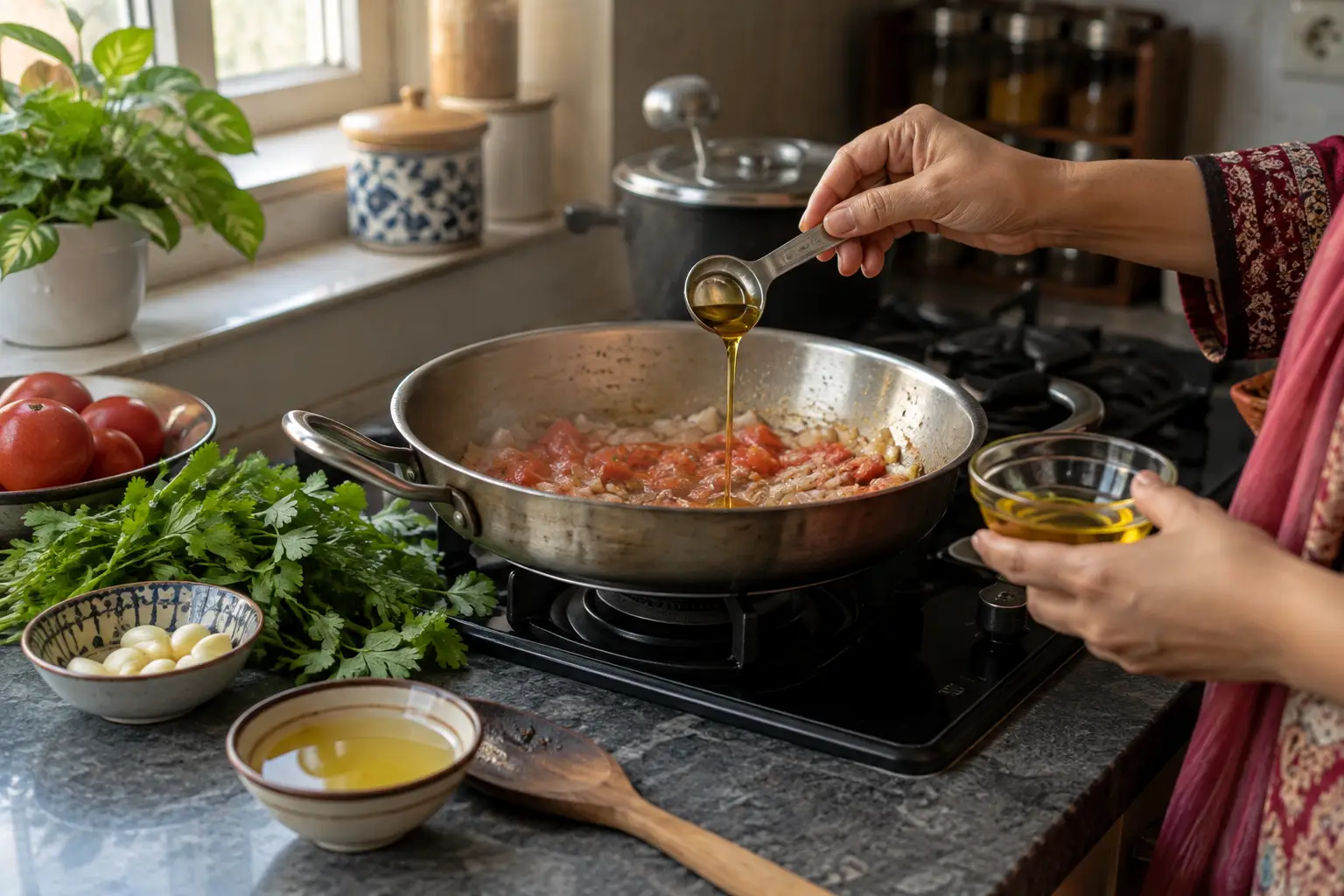
Before switching on the hob, measure the recipe's planned oil into a small bowl. Take any oil needed during cooking from that bowl, then put the bottle away.
This is not about weighing everyone's dinner. It is about making the ingredient visible before it disappears into the pot.
Use proper measuring spoons if possible. A standard teaspoon is 5 ml and a tablespoon is 15 ml; an ordinary cutlery spoon may be different.
Keep the numbers in perspective:
- One teaspoon of oil: roughly 40 calories, no protein.
- One tablespoon of oil: roughly 120 calories, no protein.
- Two tablespoons removed from a six-serving pot: roughly 40 fewer calories per serving, assuming equal distribution.
Those are estimates, not a promise about your finished meal. If you want to calculate the whole recipe, use this guide to tracking calories in homemade Pakistani food.
Check complete: Your cooking oil has a planned amount before the pan gets hot.
3. Fix Heat and Sticking Before Adding More Oil
Food sticking does not always mean it needs more fat. The heat may be too high, the pan may be crowded, or the ingredients may need stirring.
Start with a suitable pan in good condition. For onions and masala, use moderate heat rather than trying to rush everything on the highest setting.
When a moist onion or tomato mixture starts catching, lower the heat. If there is no pool of hot oil, a small splash of water can loosen the browned bits. Stir, let the water cook away and continue.
Do not pour water into hot pooled oil: it can splatter. Water is a tool for a moist cooking mixture, not for deep-frying.
Other useful fixes include:
- Cutting onions evenly so some pieces do not burn before others soften.
- Giving tomatoes time to release their moisture.
- Using a lid briefly when the recipe suits steaming and softening.
- Cooking in batches when a crowded pan prevents proper browning.
You may need a few extra minutes. That is often more useful than another unmeasured pour.
Check complete: You have checked heat, moisture and pan space before reaching for oil.
4. Build Flavour Without Chasing an Oil Layer
A visible layer of oil is not the only sign of a good salan. Your meal can taste satisfying without leaving a shiny pool on the plate.
Give ginger, garlic, tomatoes and spices time to cook properly. Stir ground spices into a moist mixture so they do not burn in a nearly dry pan.
Use finishing ingredients to bring the flavour back into focus:
- Lemon juice for brightness.
- Fresh coriander for freshness.
- Green chilli if you enjoy heat.
- Roasted, crushed cumin for aroma.
- A little garam masala near the end, where appropriate.
These do not recreate every effect of oil, but they help a lighter dish taste deliberate rather than unfinished.
For chicken salan, soften the onions with the measured oil, cook the ginger and garlic, then add tomatoes and spices. Let the tomatoes soften before adjusting the gravy with water. Cook the chicken thoroughly and finish with coriander or lemon.
For dal, keep a small measured tarka if you enjoy it. You do not need to remove the part that makes the meal appealing; you can simply make it smaller.
Check complete: The dish tastes good because the ingredients are cooked well, not because you kept adding oil.
5. Check Every Stage Where Extra Fat Enters
Sometimes the main pot is already fairly light. The extra oil arrives elsewhere.
Check whether you are also:
- Frying onions separately for a topping.
- Frying potatoes before adding them to the gravy.
- Adding a second tarka to leftovers.
- Brushing roti with ghee automatically.
- Pouring oil over vegetables before roasting without measuring it.
Choose one change that keeps the meal enjoyable. Roast potatoes with measured oil instead of frying them first. Reheat salan gently with a little water if needed, rather than starting another oily base.
For bhindi, dry it well after washing and use a wide pan. Avoid crowding it, and test a smaller measured amount of oil. Expect a slightly different texture from a heavily fried version.
An air fryer is optional, not essential. A normal oven or suitable pan can help you use less oil too. Oil sprays also contain calories; repeated long sprays can add up.
Switching from one cooking oil to another does not create a large calorie saving. Ghee, butter and oils are not identical foods, but replacing oil with a generous amount of another fat can undo your intended reduction.
Check complete: You have checked the toppings, reheating and side dishes—not just the first pour.
6. Agree on a Shared-Kitchen Approach
If your wife, parents or housemates cook, do not turn dinner into a criticism of their food.
Try: “Can we test a little less oil in this dish? I still want to eat the same dinner.”
Offer to help with chopping, washing up or cooking the next batch. A request lands better when it does not create extra work for someone else.
In shared accommodation in the Gulf, you may cook a large pot between several men. Agree on the oil amount for that pot rather than expecting separate diet meals. Keep the measuring spoon with the shared cooking supplies.
If meals are provided at work or in accommodation, your control is smaller. Choose less oily options when available, serve more of the chicken, lentils or vegetables, and take less visibly oily gravy. This cannot remove oil already mixed into the dish, so avoid treating it as an exact calorie calculation.
You do not need special products for this approach. These budget-friendly fat-loss ideas can help you keep changes affordable.
Check complete: Your plan fits the person cooking and the kitchen you actually use.
7. Keep the Rest of the Meal Satisfying
Reducing oil should not mean reducing dinner to a tiny bowl of gravy. Keep enough food to make the meal useful after a long shift.
For example, a dinner could include:
- 120 g cooked skinless chicken breast: around 200 calories and 37 g protein, before gravy.
- One medium plain roti made with 30 g whole-wheat flour: around 100–110 calories and 3–4 g protein.
- A generous serving of vegetables or salad.
- Your lighter homemade gravy, counted separately if you track.
These are ingredient estimates, not a fixed prescription. Chicken cuts, roti sizes and recipes vary. Your portions should suit your needs and hunger.
Try the cooking checklist for two weeks. Notice whether meals still taste good, whether your planned oil amount is realistic, and whether you are replacing the saved calories with extra snacks. Judge weight trends over several weeks rather than one morning.
Keep regular walking and strength training in your week too. Lower-oil cooking is one useful part of fat loss, not a replacement for the wider routine.
Check complete: You can repeat the meal without feeling you need a second dinner later.
Get Help Making the Checklist Fit Your Week
Coach Usman is a Level 3 Personal Trainer, weight loss coach, offering 1-on-1 online coaching through the My Coach app. The goal is a workable food and training plan, not a separate menu that makes family life harder.
Explore support from a personal trainer in Pakistan, or see how a weight loss coach pakistan approach can fit familiar meals and busy weeks.
Want a plan built around your job and your food? Start online coaching with Coach Usman at coachusman.com.
This is general fitness information, not medical advice. Please talk to a doctor before changing your diet or exercise routine, especially if you have a health condition.
FAQ
Do I have to stop cooking with oil to lose weight?
No. Measured amounts of oil can fit a fat-loss plan. Reducing an unnecessarily large amount can lower a meal's calories, but your overall food intake still matters.
How much oil should I use in a Pakistani curry?
There is no single amount for every curry. Pot size, ingredients, servings and cooking method all matter. Measure your usual amount, try roughly a quarter less, and adjust gradually based on taste and cooking results.
Is olive oil lower in calories than other cooking oils?
No. Most cooking oils provide similar calories per spoon. For this checklist, measuring the amount matters more than swapping one oil for another.
Can I reduce belly fat just by using less oil?
Using less oil may help you create a calorie deficit, but it cannot target belly fat specifically. Overall eating habits, activity and consistency matter. Check with your doctor if you have a medical condition.
Coach Usman, 12+ years of coaching experience
1:1 online coach for Pakistani men worldwide, building fat-loss plans around real jobs, shifts and desi food.
coachusman.comWant a coach who builds the plan around you?
Coach Usman builds your diet and training around your job, your schedule and the desi food you already eat.
Start with Coach UsmanComments (0)
No comments yet. Be the first.