In this article
- 7 AM: Set Up How to Track Calories in Homemade Pakistani Food
- 7:15 AM: Build Breakfast From Its Ingredients
- Measure Roti by the Flour, Not Its Appearance
- 8 AM: Capture the Shared Recipe Before Work
- Count Oil Without Guessing the Spoon Size
- 12:30 PM: Turn the Cooking Pot Into a Lunch Portion
- Log the Rest of Lunch Separately
- 3:30 PM: Make a Reasonable Estimate When You Did Not Cook
- 6 PM: Keep Training Separate From the Food Calculation
- 8 PM: Serve Dinner Without Weighing Everyone’s Plate
- 9:30 PM: Save What Worked, Then Close the App
Want a plan built around your job and desi food? Try 1:1 online coaching with Coach Usman.
The anda bhurji is still in the pan when your food app offers five different calorie counts for the same breakfast.
One entry says 180 calories. Another says 350. None tells you how much oil went into the pan.
Learning how to track calories in homemade pakistani food starts with a simple change: track your recipe, not a random dish name. You can then use that recipe again instead of searching from scratch at every meal.
Here is a morning-to-night routine for doing it around work, shared cooking, and family dinner. Move the times to fit your shift. The order matters more than the clock.
7 AM: Set Up How to Track Calories in Homemade Pakistani Food
Before breakfast, get three things ready:
- A digital kitchen scale that measures grams.
- A food-tracking app with a saved-recipe feature, or a basic notebook.
- The packaging from ingredients you use regularly.
You do not need an expensive scale or a separate diet menu. You need a repeatable way to estimate what goes into your food and what reaches your plate.
Tracking can help you understand your intake. Fat loss still depends on maintaining a calorie deficit over time, not simply recording meals.
Start with foods you eat often. Saving your usual breakfast and two family recipes is more useful than spending an hour researching an occasional mithai.
Track the recipe once. Make the next meal easier.
7:15 AM: Build Breakfast From Its Ingredients
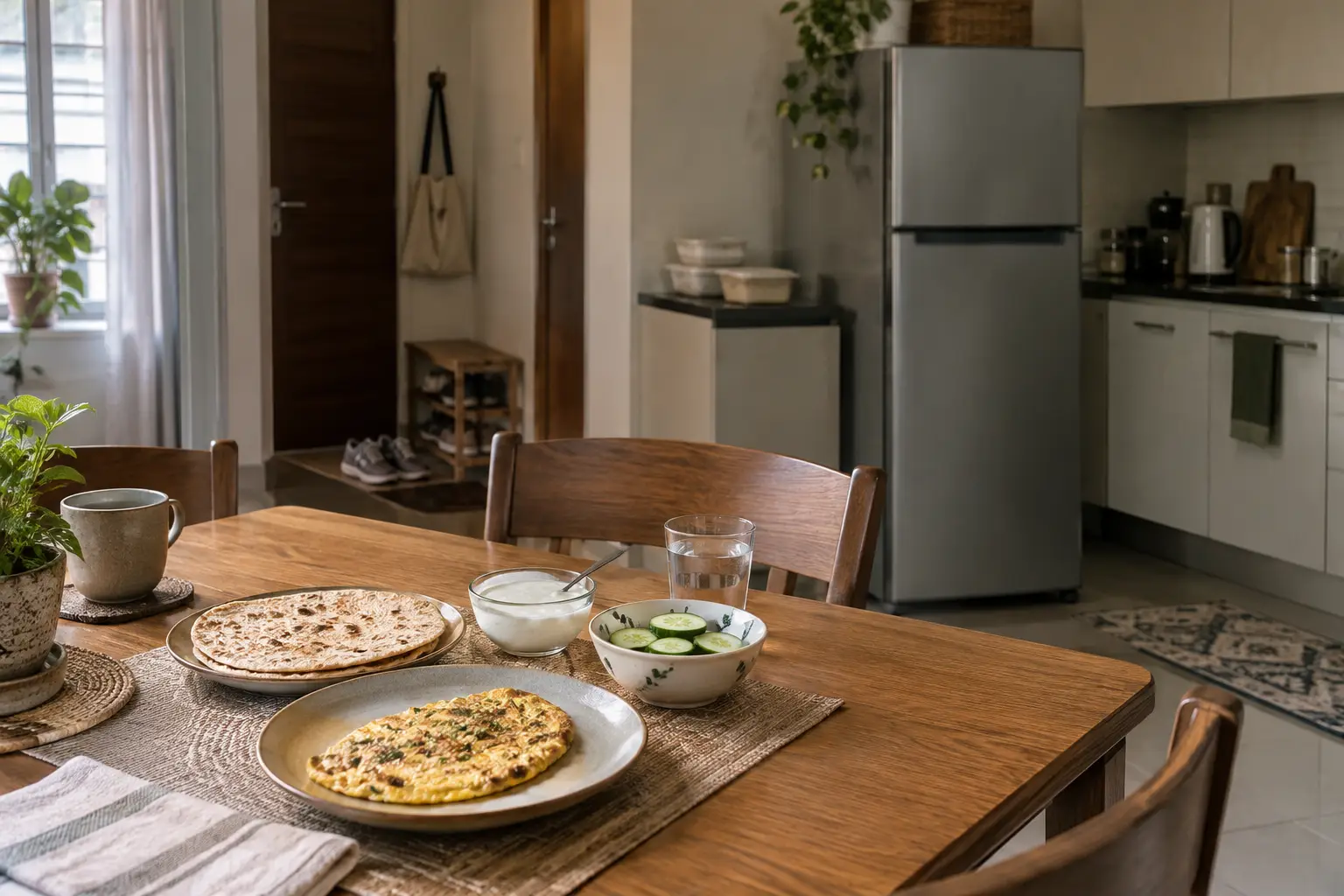
For anda bhurji, enter the eggs, vegetables, and cooking oil separately. A simple single-person example could be:
- Two large eggs: about 145 calories and 13 g protein.
- 100 g combined tomato and onion: roughly 35 calories.
- 5 g oil: about 45 calories.
That makes approximately 225 calories and 14 g protein, before bread or roti. These are estimates; egg size, ingredient amounts, and database entries vary.
If you make double and split it evenly with someone else, record half the recipe. Do not enter the whole pan as your breakfast.
Measure Roti by the Flour, Not Its Appearance
A roti made with 35 g whole-wheat atta contains roughly 120 calories and 4 g protein before added oil or ghee. Water adds weight but no calories.
For a batch, weigh the total flour and divide by the number of similar-sized rotis. For example, 280 g flour divided into eight equal dough balls gives 35 g flour per roti.
If sizes vary a lot, divide the dough into equal portions before cooking. You do not need perfectly round rotis; you need reasonably consistent ones.
Save breakfast in your app. Tomorrow, change only what actually changes.
8 AM: Capture the Shared Recipe Before Work
If lunch or dinner is being cooked now, this is your best chance to record it. Asking about ingredients after the pot is empty usually produces guesses.
Offer to weigh ingredients or help with prep. Avoid making the person cooking feel inspected.
Record:
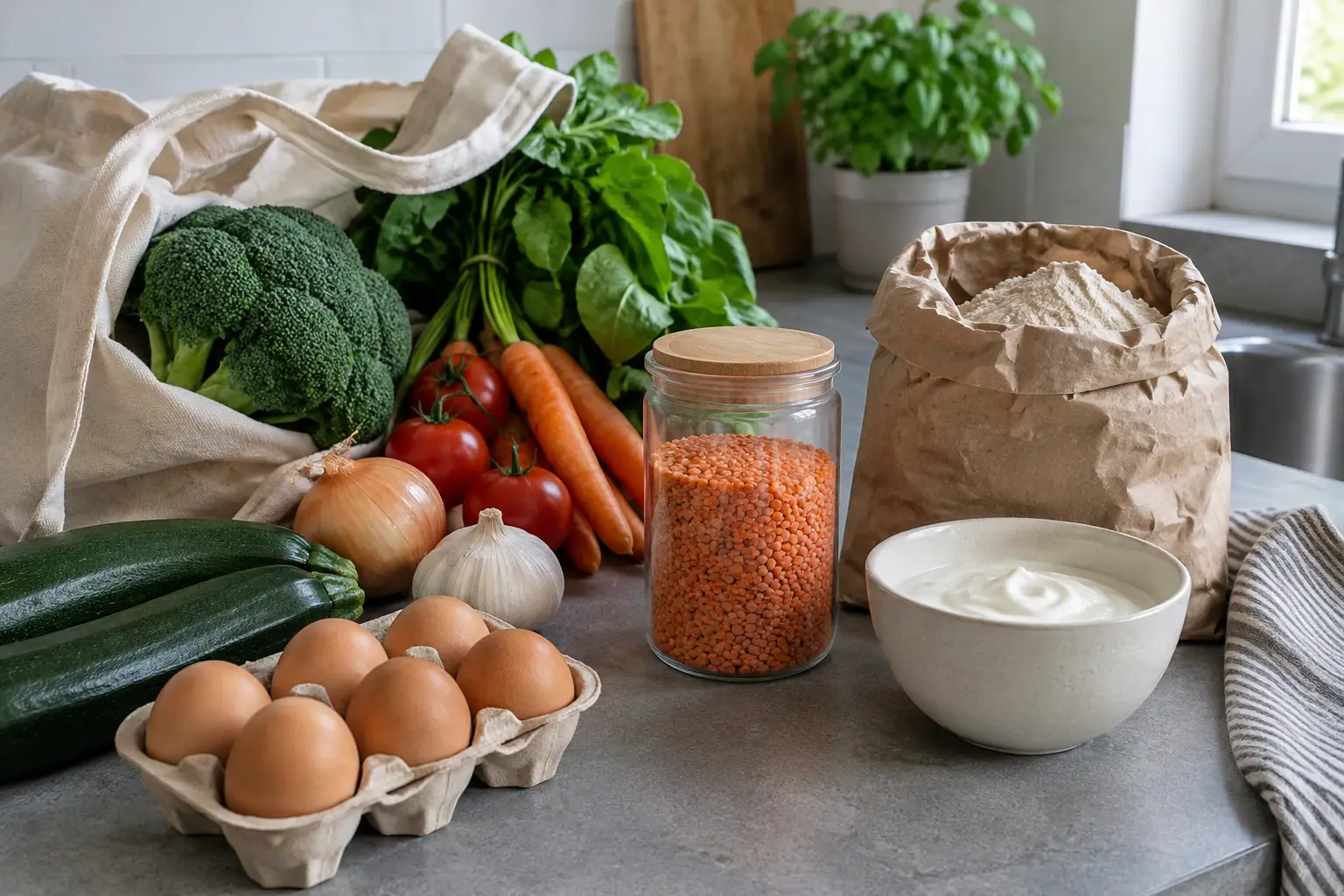
- The main ingredient, such as dry lentils or raw boneless meat.
- Oil or ghee in grams.
- Onions, tomatoes, potatoes, yoghurt, and other additions.
- Any packaged sauces, using their labels.
Match the food entry to the state you weighed. Dry lentils need a dry-lentil entry. Cooked lentils need a cooked-lentil entry. The same rule applies to rice and meat.
Cooking changes water content. It does not make dry and cooked weights interchangeable.
Count Oil Without Guessing the Spoon Size
Weigh the oil bottle before and after pouring. If it is 25 g lighter, about 25 g oil went into the dish: roughly 225 calories across the whole recipe.
For an ordinary curry where the oil stays in the pot, include all the oil added. Deep-fried food is harder because some oil remains behind; do not assume the entire frying pan’s oil was eaten.
12:30 PM: Turn the Cooking Pot Into a Lunch Portion
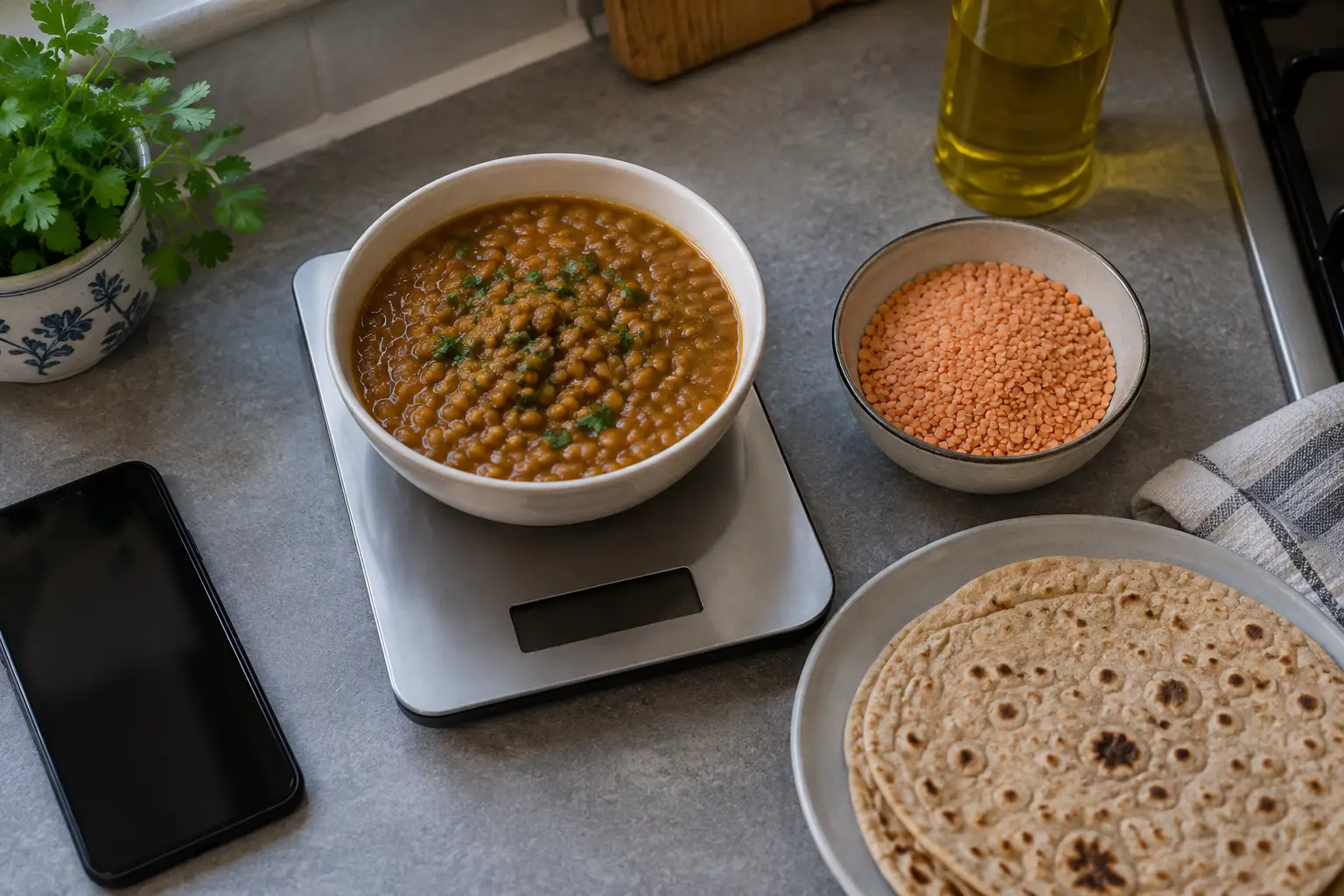
A saved recipe needs one more number: the final cooked weight.
Here is a worked example for a shared masoor dal recipe. The numbers are illustrative estimates, not a fixed calorie count for every household’s dal:
- 250 g dry red lentils: approximately 880 calories and 63 g protein.
- 25 g oil: approximately 225 calories.
- 200 g onion: approximately 80 calories.
- 300 g tomatoes: approximately 55 calories.
- Garlic and spices: approximately 20 calories.
The batch contains roughly 1,260 calories and 68 g protein in total.
Suppose the finished dal weighs 1,800 g, excluding the pot. You can calculate:
1,260 ÷ 1,800 = 0.7 calories per gram.
A 350 g serving therefore contains about 245 calories and 13 g protein.
In a recipe app, enter the final cooked yield if that feature is available. Otherwise, use the calculation above. Do not put a hot, heavy pot directly on a small kitchen scale; transfer food safely into suitable containers and add their food weights together.
Log the Rest of Lunch Separately
If you add 150 g cooked plain rice, that contributes roughly 195 calories and 4 g protein. Your dal and rice together would be around 440 calories and 17 g protein.
Record any yoghurt, pickle, or extra toppings separately. For packaged yoghurt, use its label because protein and calories vary between products.
Stir the dal before serving so the portion is reasonably representative. This method works less neatly for dishes with large meat pieces, where one serving may contain much more meat than another.
For more affordable meal ideas, see fat loss on a budget.
3:30 PM: Make a Reasonable Estimate When You Did Not Cook
Perhaps you work in Qatar and share a kitchen with several other men. Someone else cooked lunch, and nobody weighed the ingredients. You can still make a useful estimate.
Ask two practical questions:
- What were the main ingredients?
- Roughly how much oil went into the whole batch, and how many people did it feed?
Choose a database entry with a clear weight and a plausible ingredient description. Avoid entries that only say “one plate” with no serving details.
If possible, weigh your portion. If not, use the same bowl and take a quick photo for reference. A photo helps you remember the meal; it cannot reveal hidden oil accurately.
For biryani, check whether the entry includes meat and oil. Do not log a complete biryani entry and then add those ingredients again unless they were genuinely extra.
Choose a reasonable estimate, mark it as estimated, and move on. Do not deliberately select the lowest result just because it makes the daily total look better.
6 PM: Keep Training Separate From the Food Calculation
Your food log is not a bill that exercise must pay off.
If today is a planned training day, a short home session could include:
- Chair squats: two sets of 8–12 controlled repetitions.
- Incline push-ups against a stable surface: two sets of 6–12.
- One-arm backpack rows: two sets of 10–15 per side.
Warm up first, use a secure load, and finish each set while you could still do another two or three controlled repetitions. Stop if a movement causes pain.
This is a simple fallback, not a complete long-term training programme. Strength training helps support muscle retention while losing fat.
Avoid automatically adding back every calorie your watch says you burned. Those estimates can be inaccurate. If your schedule is tight, this guide to choosing between steps and gym time can help you organise movement without turning it into punishment.
8 PM: Serve Dinner Without Weighing Everyone’s Plate
Use the saved recipe and weigh only your own serving. Your family does not need to follow your tracking routine.
For a mixed dish such as chicken karahi, distribute the chicken reasonably evenly before dividing the gravy. A gravy-heavy serving and a chicken-heavy serving will not have identical calories or protein, even at the same weight.
Bone-in meat adds another complication. Do not count bone weight as edible meat. For a first practice recipe, boneless meat is easier to track. With bone-in dishes, use an appropriate edible-meat estimate and accept that the result is less precise.
If you take seconds, record them when you serve them. It is easier than trying to remember the amount at bedtime.
Dinner should still feel like dinner. Once the portion is logged, put the phone away.
9:30 PM: Save What Worked, Then Close the App
Spend two minutes checking for missed cooking fats, drinks, snacks, or second servings. Then stop.
Save the recipes you are likely to repeat. Note any changes needed next time, such as weighing the finished rice or checking the yoghurt label.
Review your weight trend over several weeks alongside hunger, energy, and training. One morning’s scale reading cannot tell you whether yesterday’s calorie estimate was correct. Before eating less, check whether your logging has been reasonably consistent.
If tracking becomes distressing or takes over family meals, step back. A simpler portion-based approach may suit you better.
For tailored help, explore the how to track calories in homemade pakistani food page or learn about working with a personal trainer in Pakistan.
Coach Usman is a Level 3 Personal Trainer, weight loss coach, offering 1-on-1 online coaching through the My Coach app. Want a plan built around your job and your food? Start online coaching with Coach Usman at coachusman.com.
This is general fitness information, not medical advice. Please talk to a doctor before changing your diet or exercise routine, especially if you have a health condition.
FAQ
Do I need to weigh homemade food forever?
No. Weighing common recipes for a while can teach you what your usual portions contain. You can later use saved recipes and familiar serving sizes, checking again when ingredients or portions change.
Should I weigh rice before or after cooking?
Either works if you use the matching database entry. For a shared recipe, record the dry rice and other ingredients, then weigh the finished batch to calculate your portion.
How accurate are calories for homemade Pakistani food?
They are estimates. Measuring ingredients, including oil, and dividing by the cooked batch weight makes them more useful. Uneven meat portions, bones, and unknown ingredients reduce precision.
Can I use this approach if I have a medical condition?
Check with your doctor if you have a medical condition. Ask whether calorie tracking or changing your intake is appropriate for you before starting.
Coach Usman, 12+ years of coaching experience
1:1 online coach for Pakistani men worldwide, building fat-loss plans around real jobs, shifts and desi food.
coachusman.comWant a coach who builds the plan around you?
Coach Usman builds your diet and training around your job, your schedule and the desi food you already eat.
Start with Coach UsmanComments (0)
No comments yet. Be the first.