In this article
- Mistake 1: Picking the first search result
- Mistake 2: Treating a food name as a full recipe
- Mistake 3: Ignoring the serving size
- Mistake 4: Comparing entries without checking cooked or raw weight
- Mistake 5: Trusting a dish entry with no recipe details
- Mistake 6: Trying to make every number exact
- Mistake 7: Changing entries every day
- Mistake 8: Judging your progress by one app entry
- How to check if a calorie tracking app has accurate Pakistani food entries
Want a plan built around your job and desi food? Try 1:1 online coaching with Coach Usman.
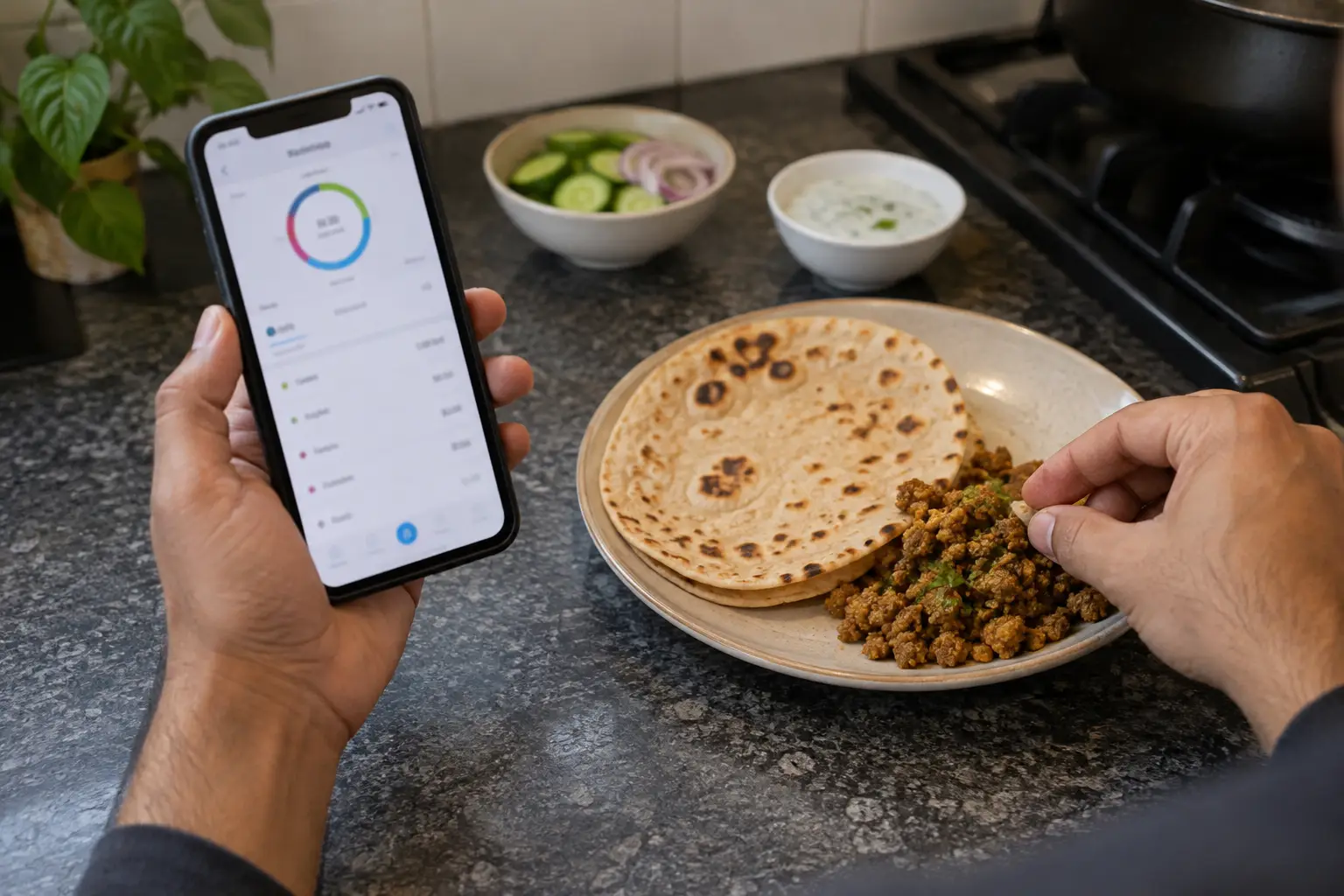
You search for a plate of qeema and roti in a calorie app, but several entries show different numbers for what looks like the same meal. If you want to know how to check if a calorie tracking app has accurate Pakistani food entries, do not assume the first result is right—or give up on tracking altogether. Check what each entry actually describes, then use the closest match consistently.
I coach men who eat Pakistani food at home, at work and during long shifts. An app can help you notice patterns, but a database entry is only as useful as its portion and recipe details. Here are the mistakes I see people make, and the fixes I recommend.
Mistake 1: Picking the first search result
The first result may be a generic entry, a user-submitted meal or a recipe from a different preparation style. “Chicken karahi,” for example, can mean different portion sizes and amounts of oil. A single name does not guarantee a close nutritional match.
Fix: Open a few results before logging. Compare the serving unit, calories and listed nutrients. Check whether the result says cooked or raw, and whether it describes a whole dish or just one ingredient. If there is no useful detail, treat it as a rough estimate rather than a precise measurement.
It can help to search using more than one description, such as the dish name plus “homemade,” or the main ingredient plus “cooked.” Still, do not assume a more detailed-looking entry is automatically more accurate. Check whether its details fit the food on your plate.
Mistake 2: Treating a food name as a full recipe
A food entry may represent plain cooked chicken, while your meal includes gravy and oil. Or an entry for a roti may use a different size or flour amount than the one on your plate. These details can change the total.
Fix: Match the meal as closely as you can. If the app has a recipe feature, add the ingredients you actually used and divide the total into the number of portions served. When that is not practical, log the main ingredients separately and make a reasonable estimate for the oil or gravy.
At home, ask whoever cooked what went into the dish if they know. You do not need to turn dinner into an investigation; even a rough note such as “home-cooked, moderate oil” gives you helpful context for next time.
A consistent estimate you understand is more useful than a precise-looking number you cannot explain.
Mistake 3: Ignoring the serving size
An entry may list calories per 100 grams, one small piece or one cup. If you log one serving without checking what “one serving” means, your record may not match what you ate. The same issue applies to a cup of cooked rice or a bowl of dal: household portions vary.
Fix: Read the serving unit before entering the amount. If you can, use a kitchen scale occasionally to learn what your usual portion weighs. You do not need to weigh every meal forever. A few checks can help you see whether your usual roti, rice portion or serving spoon is closer to the app’s example.
If you are eating from a shared dish, estimate the amount you served yourself—not the size of the whole pot. For practical advice on estimating food from a shared plate, see how to count calories in a shared plate of food. Focus on the portion you actually ate, even if you cannot measure it exactly.
Mistake 4: Comparing entries without checking cooked or raw weight
Meat, rice and lentils can change weight during cooking as they absorb or lose water. A raw-weight entry and a cooked-weight entry are not interchangeable. Search results may show both, even when the names look almost identical.
Fix: Match the state of the food you measured. If you weighed cooked chicken, choose an entry for cooked chicken. If your meal is a mixed dish, use its recipe ingredients or a close prepared-food entry instead of trying to apply a raw ingredient value to the whole plate.
When you cannot tell which version the app uses, avoid false precision. Make a note of the entry you chose and use it again for a similar meal. The goal is a repeatable record that helps you adjust your routine, not a perfect laboratory measurement.
Mistake 5: Trusting a dish entry with no recipe details
A label such as “homemade qeema” may sound specific, but the recipe could differ from yours in meat type, added oil and portion size. Packaged food labels may be more specific, but a homemade entry may be only a broad estimate.
Fix: Look for details in the listing, not just a familiar food name. If the recipe is unclear, compare it with a simple ingredient-based estimate. For packaged items, use the nutrition label and the portion you actually ate when those details are available.
I tell clients to use the same approach for repeated meals. If you cook one version of qeema regularly, save that version or create a personal recipe where the app allows it. Then update it if you change the ingredients or the number of servings. For more guidance on logging a dish you prepare at home, read how to track calories in homemade Pakistani food.
Mistake 6: Trying to make every number exact
A calorie app cannot know how much oil was used in a shared handi unless that information is entered. Restaurant portions can vary, and family recipes are rarely measured the same way each time. Chasing an exact number can make tracking feel like another job after work.
Fix: Prioritize the details that matter most for your routine: portion size, cooking oil, and foods you eat often. For an occasional meal outside the home, choose a sensible estimate, log it, and move on. Do not skip the rest of your day because one entry was uncertain.
Small additions can also be easy to overlook. For a practical approach to logging them, read how to include sauces and chutneys in calorie tracking. The same idea applies to other additions: record what you can, without expecting an app to know what was in your kitchen.
Mistake 7: Changing entries every day
If you pick a different result for the same home-cooked meal each time, your food log becomes hard to compare. A meal may appear to change dramatically even though the recipe and portion were similar.
Fix: Choose one reasonable entry for a repeated meal, make a note of what it represents, and use it consistently. Review it if your recipe changes or you learn that the serving size was far off. Consistency makes the weekly pattern more useful than switching between several unverified entries.
Tracking is just one way to learn about your habits. It does not need to be perfect to help you notice patterns, but it does need to be consistent enough to compare similar days and meals.
Mistake 8: Judging your progress by one app entry
One entry cannot tell you whether your overall plan is working. Food estimates have limits, and body weight can move from day to day. It is more useful to follow your routine and look at repeated measurements over time than to react to one meal or one weigh-in.
Fix: Keep your tracking method steady for a period, and compare your overall habits and progress rather than searching for a perfect entry after every meal. If the trend is not moving the way you expect, review portions, cooking methods and consistency before making several big changes at once.
My coaching advice is simple: use the app as a tool, not a judge. If food logging becomes stressful, choose a simpler method that you can keep using. The point is to make the record useful in real life, not to spend your evening trying to prove that every number is exact.
How to check if a calorie tracking app has accurate Pakistani food entries
Use this quick check whenever a search result looks uncertain:
- Does the entry match the food preparation and ingredients?
- Is the serving size clear, and does it match what you ate?
- Does the entry describe cooked or raw food correctly?
- Are recipe details or nutrition information available?
- Can you use the same entry consistently for a similar meal?
If several answers are no, look for another listing, build a recipe from ingredients, or make a reasonable estimate and note the uncertainty. The best app entry is not always the one with the most impressive detail. It is the one that reflects your meal well enough to help you make a practical decision.
A useful log should fit your real life: family meals, work breaks, and the food you enjoy. If you want support with your overall fitness plan, you can learn about 1:1 coaching for Pakistani men.
Want a plan built around your job and your food? You can explore coaching options on the site and decide whether 1:1 coaching is a fit for you.
This is general fitness information, not medical advice. Please talk to a doctor before changing your diet or exercise routine, especially if you have a health condition.
FAQ
How can I tell if a calorie app entry for Pakistani food is accurate?
Check whether the serving size, cooking method, ingredients and cooked or raw state match your food. If the details are missing, use a reasonable estimate consistently rather than treating the number as exact.
What should I do if my calorie app does not have my homemade meal?
Add the ingredients and divide the total by the number of portions if the app supports recipes. Otherwise, choose a close entry, adjust the serving size and make a note of your estimate.
Should I log Pakistani food by grams or by household portions?
Use the unit that best matches the app entry. Weighing a usual portion occasionally can help you understand how it compares with a cup, piece or serving spoon, but you do not need to weigh every meal.
Why do calorie apps show different numbers for the same Pakistani dish?
Entries may use different recipes, ingredient amounts, cooking methods and portion sizes. User-submitted entries can also vary in detail, so compare what each result describes rather than relying on the dish name alone.
Should I use a raw or cooked entry for meat, rice or lentils?
Choose an entry that matches how the food was measured. A raw-weight entry and a cooked-weight entry are not interchangeable because food can gain or lose water during cooking.
Do I need to track every calorie for an app to be useful?
No. Tracking is one way to notice patterns, but it does not need to be perfect. Use a consistent method you can maintain, and choose a simpler approach if detailed logging becomes stressful.
Coach Usman, 12+ years of coaching experience
1:1 online coach for Pakistani men worldwide, building fat-loss plans around real jobs, shifts and desi food.
coachusman.comWant a coach who builds the plan around you?
Coach Usman builds your diet and training around your job, your schedule and the desi food you already eat.
Start with Coach UsmanComments (0)
No comments yet. Be the first.