In this article
- What should I do when the app has no accurate entry?
- How can I estimate portions without weighing every ingredient?
- Should I create my own entry for a Pakistani recipe?
- How do I log oil, sauces, and shared dishes?
- What if app entries show very different calorie numbers?
- How can I tell whether my calorie estimates are useful?
- Can I lose fat without exact calorie counts?
- What should I do next when app entries are wrong?
Want a plan built around your job and desi food? Try 1:1 online coaching with Coach Usman.
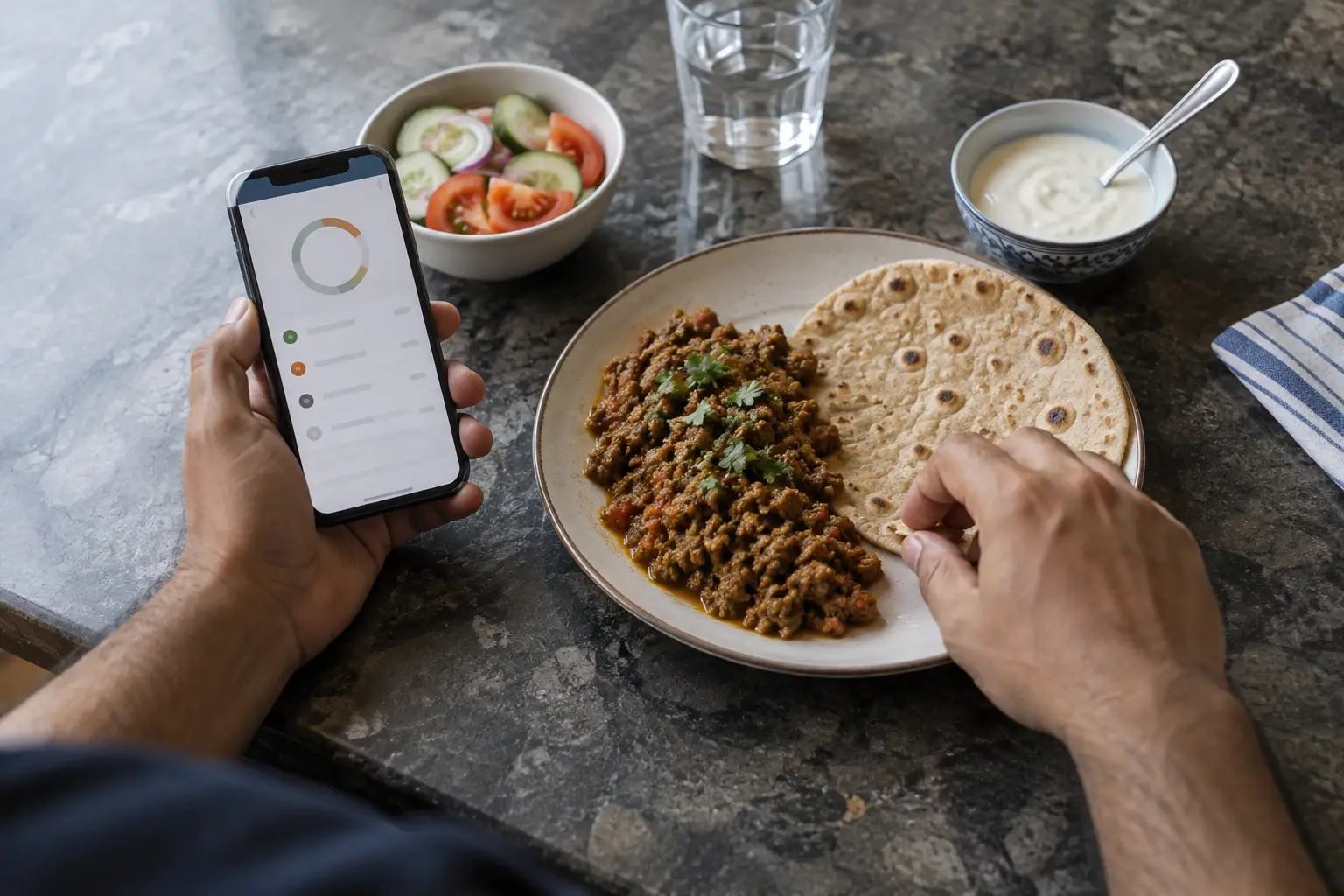
You enter a homemade plate of qeema and roti into your calorie app, and the result looks nothing like the meal in front of you. If you are wondering how to track calories when pakistani food app entries are wrong, remember that an app estimate is not a lab measurement. Your goal is to build a consistent picture of what you eat, not to find a perfect number for every family recipe.
This matters when recipes change from one kitchen to another. The amount of oil, the size of a roti, and the serving of qeema can all vary. A useful log makes those differences visible and helps you make decisions over time.
What should I do when the app has no accurate entry?
Choose the closest entry and improve the estimate with details you can observe. For a homemade meal, you might log the main ingredients separately rather than selecting a generic dish with an unknown recipe.
For example, note one medium roti, a serving of qeema, and any visible oil or added ingredients. If you know the amount of meat in a recipe, divide it by the number of portions. If you do not, use a similar entry consistently and treat it as an estimate.
Do not switch between several random entries for the same meal just because one gives a lower number. That makes your record harder to compare from week to week.
How can I estimate portions without weighing every ingredient?
Use a repeatable serving description. You could record a small, medium, or large roti, or note that your serving of daal filled a particular bowl. A kitchen scale can help when it is practical, but you do not need to weigh every bite to begin learning your habits.
Try these steps:
- Take a quick photo before eating, especially for meals served family-style.
- Use the same plate or bowl when you can.
- Describe the serving in everyday terms, such as one ladle of daal or one palm-sized piece of meat.
- Record calorie-dense additions such as cooking oil, ghee, sauces, and fried toppings when you know they are included.
- Use the same estimate for a repeated meal unless the portion or recipe clearly changes.
A roti made with more flour or a generous pour of oil can have more calories than a smaller, plain version. That does not mean you need to guess every ingredient perfectly. It means your best estimate should reflect the portion you actually ate.
A consistent estimate is more useful than a precise-looking number you cannot repeat.
Should I create my own entry for a Pakistani recipe?
You can, if the app lets you save a recipe and you know the ingredients or approximate portions. Add the amounts for the whole recipe, then record the serving you ate. If you do not know the recipe details, avoid entering made-up ingredient amounts to create a number that looks exact.
A simple method for a shared pot is to record the ingredients you know, estimate how many servings it made, and divide the total across those servings. If the family takes different-sized portions, your share will still be an estimate. That is fine as long as you use a similar method each time.
For meals from a restaurant or a relative’s kitchen, you may not have enough information to calculate a recipe. Select the closest available dish, note that it was an estimate, and return to your usual tracking routine at the next meal. For more advice on choosing a tool, see how to choose a calorie tracking app with Pakistani foods.
How do I log oil, sauces, and shared dishes?
Pay attention to ingredients that are easy to miss because they are mixed into a dish. Oil used in cooking can add up across a recipe, but it is difficult to estimate how much ended up in one serving when several people shared the pot.
When you cook at home, you can get a more useful estimate by noting the amount used in the whole recipe and the number of portions. When somebody else cooks, make your best reasonable estimate rather than pretending you know the exact amount. If the dish looks richer than usual, record that difference in a note.
For shared dishes, start with your own serving. If you take another helping, add it to your log. This is more useful than trying to calculate the entire pot while people are waiting at the table.
What if app entries show very different calorie numbers?
Compare what each entry describes before choosing one. Check the serving size, whether the food is cooked or uncooked, and whether the listing includes oil or other ingredients. A value for a plain ingredient may not match a prepared dish.
If the entries still vary, choose the one that seems most similar to your food and keep the choice consistent. Avoid taking the lowest number by default. The point is not to punish yourself with a high estimate; it is to avoid changing your method to make the log look better.
Tracking can also help you spot patterns without needing every entry to be exact. You might notice that portions grow when you arrive home very hungry, or that weekend meals are harder to estimate. Use those observations to make one practical change, such as serving your plate before sitting down or deciding your portion before the meal begins.
How can I tell whether my calorie estimates are useful?
Look at your eating pattern and progress across several weeks, not one meal or one day. Body weight can move up and down for many reasons, so use regular weigh-ins under similar conditions and consider the trend. Waist measurements and how your clothes fit can provide additional context.
If your trend is not moving in the direction you want after a reasonable period, review your portions and logging habits before blaming one app entry. Are you recording cooking oil when you know it was used? Are drinks, snacks, and second servings included? Are your estimates different each time you eat the same meal?
If tracking every detail becomes tiring, use a simpler approach for familiar meals and focus on consistency. You can also read how to lose weight without counting calories every day for ways to use repeatable habits alongside or instead of daily logging.
Can I lose fat without exact calorie counts?
Yes. A calorie log is one way to understand your eating habits, but it is not the only way to build a steady routine. You can use familiar portions, repeat a few filling meals, and keep an eye on your progress over time. A useful plan should fit the food you eat at home and the schedule you actually have.
If you want more structure than a food database can provide, CU Fit offers a custom diet built around foods you already eat, updated every 30 days. It also includes daily workouts that unlock as you progress, weekly check-ins with photos, weight and waist, progress charts, and a bad-day reset. Coach Usman personally reviews your progress after 6 check-ins.
CU Fit can be a practical option if searching for each homemade recipe is making you want to quit tracking altogether. You can learn more about weight loss coaching in Pakistan, or choose Premium 1:1 coaching if you want direct chat with Coach Usman and weekly check-in reviews. For pricing, visit the coaching options.
What should I do next when app entries are wrong?
Pick one repeatable way to estimate your common meals. Record the portions you can see, note uncertain ingredients, and avoid treating app results as exact. Review your eating pattern and progress over time, then make one small adjustment if needed.
You do not need a perfect food database to take useful action. You need a method you can keep using through busy workdays, family dinners, and meals cooked by somebody else.
Want a plan built around your job and your food? Start with CU Fit at coachusman.fit for an affordable custom diet and workout plan. Want Coach Usman to coach you 1:1? Choose Premium coaching at coachusman.com.
This is general fitness information, not medical advice. Please talk to a doctor before changing your diet or exercise routine, especially if you have a health condition.
FAQ
How do I track calories when a Pakistani food entry is wrong?
Choose the closest reasonable entry, record the portion you ate, and use the same estimate for similar meals. Note uncertain ingredients rather than treating the app number as exact.
Should I weigh homemade Pakistani food to track calories?
Weighing food can improve estimates when practical, but it is not essential for every meal. Repeatable portion descriptions and consistent logging can still help you notice patterns.
Can I use CU Fit if I eat Pakistani food?
CU Fit provides a custom diet built around foods you already eat, with a new diet every 30 days. It also includes workouts, weekly check-ins, progress charts, and a bad-day reset.
Coach Usman, 12+ years of coaching experience
1:1 online coach for Pakistani men worldwide, building fat-loss plans around real jobs, shifts and desi food.
coachusman.comWant a coach who builds the plan around you?
Coach Usman builds your diet and training around your job, your schedule and the desi food you already eat.
Start with Coach UsmanComments (0)
No comments yet. Be the first.